Mary Ann McCracken and Anne Devlin: Women and Rebels
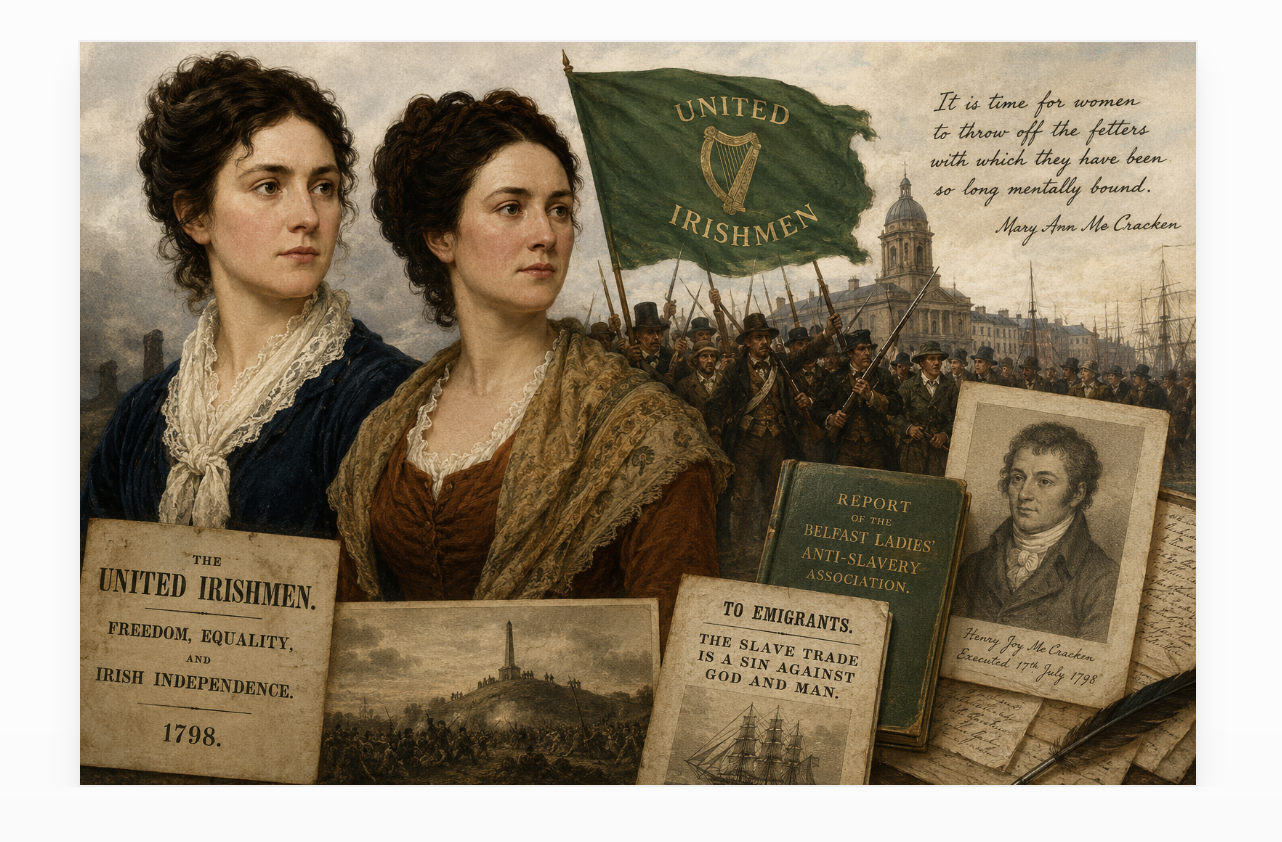
Two powerful women rising up on the side of justice not just in the Irish but the global sense
Ireland in the 1790s: A Society Divided
Ireland in the 1790s was defined by stark inequalities. Political and economic power was held exclusively by the Anglo-Irish elite, a small group of families who owned the vast majority of the land. The majority were absentee landlords whose focus was in England. Those who remained in Ireland lived in large country estates and transformed the face of Dublin, while the Irish Catholics—who made up three-quarters of the population—were relegated to tenant farming.
Under the Penal Laws, Catholics were legally barred from voting, holding legal office, and entering the legal and military professions. They were also unable to buy land. Catholic schools were banned, so in secret, hedge schools were set up in rural areas to teach children history, the Irish language, and basic mathematics.
Presbyterians faced similar exclusion under the Penal Laws and were also alienated from public life. Like many others, they were inspired by the democratic ideals of the American and French Revolutions. The Society of United Irishmen was formed by Theobald Wolfe Tone, James Napper Tandy, and Thomas Russell. Its original aim was constitutional parliamentary reform and Catholic emancipation.
Tensions grew following the outbreak of war between Revolutionary France and England in 1793. The revolution in France shook the British authorities, and the path to peaceful reform became blocked. It was known that the United Irishmen were sympathetic to the French Revolution, and the movement was driven underground. They now sought to break all ties with Britain and create an independent Irish republic.
The 1798 Rebellion
The main rebellions of the United Irishmen took place in 1798, with significant outbreaks in the provinces of Leinster and Ulster. The rebellion was most intense in County Wexford, which saw the largest and most sustained fighting. In Ulster, the rebellion erupted in June, centred in the counties of Antrim and Down. Later that year, a French force landed at Killala Bay in County Mayo, and further unrest followed in County Galway and County Mayo during the winter of 1798–1799.
Mary Ann McCracken: A United Irishwoman
Mary Ann McCracken was born into this atmosphere of political ferment in 1770. Her family can be described as liberal Presbyterians, and she was one of seven children. She attended a school where male and female pupils were treated equally.
Mary Ann was particularly close to her brother, Henry Joy McCracken (born on 31 August 1767). Henry was a devout Presbyterian who founded a Sunday school in Belfast and started a circulating library to encourage the habit of reading and increase people's knowledge. He was a liberal thinker, drawn to the movement for reform in society and to the cause of Catholic emancipation. Alongside Thomas Russell, the librarian at the Linen Hall Library, Henry was involved in founding the Society of United Irishmen in Belfast in October 1791.
Mary Ann was a committed and active supporter of the United Irishmen. While her brother became a military leader in the 1798 rebellion, her involvement was largely behind the scenes. Here is a summary of her support:
· Providing crucial aid during the rebellion: After Henry was defeated at the Battle of Antrim, Mary Ann bravely sought him out while he was in hiding. She brought him much-needed clothes and money and was arranging for a ship to take him to America when he was captured.
· Being present at her brother's final moments: She attended his court-martial and then walked with him, hand-in-hand, to the gallows in Belfast.
· Aiding other leaders: She and her sister also found lodgings and gave support to fellow United Irishman Thomas Russell in 1803, during Robert Emmet's rebellion. She even paid a bribe to try to secure his release and later financed his legal defence and eventually his tombstone.
A Lifetime of Activism
Mary Ann's commitment to the ideals of liberty and equality extended far beyond the rebellion. She was an early advocate for women's rights and argued that the United Irishmen's calls for freedom should apply to women as well as men. She wrote that it was time for women to "throw off the fetters with which they have been so long mentally bound."
She was also a leading member of the Belfast Ladies Anti-Slavery Association and, until her late eighties, could be found at Belfast docks handing out anti-slavery leaflets to Irish emigrants bound for America. She helped poor families through the Belfast Charitable Society and campaigned for better conditions for prisoners.
Mary Ann McCracken lived a long life dedicated to social justice, embodying the principles of the United Irishmen long after the rebellion had failed. Her story, along with that of Anne Devlin, offers a powerful glimpse into the role of women at that time in Ireland's struggle for independence.
Anne Devlin
A Republican Upbringing
Anne Devlin was born in 1780 near Aughrim in County Wicklow, into a family deeply immersed in republican ideals. The Devlins were farmers, and Anne was the second of four daughters and three sons. Her father, Bryan Devlin, as well as a brother and various cousins, were members of the United Irishmen. Though her immediate family did not actively participate in the 1798 rebellion, they sheltered wounded rebels fleeing from the oppressors. Her cousins included prominent Wicklow United Irishmen such as Michael Dwyer, Arthur Devlin, and Hugh O'Byrne, and in the aftermath of the rising, Anne herself carried messages and supplies to fugitives hiding in the Wicklow Mountains.
The family's known sympathies led to their house being destroyed by yeomanry in June 1798, and Anne’s father was arrested and held in Wicklow jail until early in 1801. Following his release, the family moved to a farm at Rathfarnham, on the southern outskirts of Dublin.
Involvement in the 1803 Rebellion
It was at Rathfarnham that Anne Devlin came to the attention of Robert Emmet, who was planning a fresh insurrection. Emmet needed a safe headquarters and, in April 1803, Devlin began work at his house on Butterfield Lane as an unpaid housekeeper—in reality, a trusted co-conspirator. As Emmet famously said of her to other United men who hesitated to speak in her presence, "She is one of ours” .
Devlin played a central role in the conspiracy. She acted as a courier, carrying messages to insurgents across Dublin, and helped assemble arms and ammunition, ensuring their safe delivery to secret locations across the city. When Emmet's rebellion failed on 23 July 1803, Devlin bravely remained at headquarters to destroy incriminating material, hoping to allow Emmet and other leaders to escape.
In Emmet's house she was privy to the meetings he held in preparation for another rising in Dublin in July 1803, and she acted as a courier for him. When the rising failed and Emmet returned to Rathfarnham, Anne Devlin berated him for abandoning his followers. Yet several days later, when the yeomanry descended on the house and tortured her, she refused to divulge information on his whereabouts. During the following month, while Emmet was hiding in the Wicklow Mountains and later at Harold's Cross in Dublin, she frequently carried messages for him.
Arrest, Torture, and Imprisonment
Shortly after the rising, Devlin and her family were arrested and taken to Kilmainham Gaol where she was tortured by soldiers who stabbed her with bayonets and subjected her to repeated half-hangings in a desperate attempt to force her to reveal Emmet's whereabouts. She refused to betray him.
Later, at Dublin Castle and Kilmainham Gaol, she endured three years of imprisonment, including solitary confinement, offers of bribes (the equivalent of more than thirty years' wages), and constant psychological pressure. The harsh conditions—damp, cold cells without adequate food or exercise—took a severe toll on her health. She developed erysipelas, a painful skin disease, and went partially blind, conditions that plagued her for the rest of her life. During this time, her nine-year-old brother, James, died in prison. Despite the threats and the death of her brother, she refused to inform on Emmet.
She was finally released in late 1806, having been found in such a poor state that an official was moved to secure her freedom.
Later Life and Legacy
After her release, Anne struggled. She returned to her family, who had lost their farm and were living in poverty. She received some money from Emmet's supporters and worked as a maid and companion. In 1811, she married a drayman named William Campbell, and they had three children. For a time, she found employment as a laundress, working for several "respectable families" and, from 1825, at St Patrick's Hospital.
It was only in her final years that she sank into extreme poverty, suffering from severe rheumatism and failing eyesight. Her husband died in 1845, and her children were also in poor health. Historians and researchers who sought her out in the 1840s made efforts to raise money to support her, but the public response was far from generous.
Anne Devlin died on 18 September 1851 in a room in the Coombe, Dublin, and was buried in Glasnevin cemetery. A gravestone later erected by a historian described her as Emmet's "faithful servant," though she had always resented this label, considering herself a comrade in the struggle.
Conclusion
1. Both women played a role in republican struggles. Anne Devlin helped Robert Emmet with planning the rebellion and was very brave in trying to help her comrades escape. She was imprisoned and her health suffered as a consequence. Her family were republicans. Mary Ann’s family were liberal rather than republican. Mary Ann played a more supportive role.
2. More is written about Mary Ann: we can see that she had an education and was a business woman which funded her political activity. Anne and her whole family were forced into poverty because of their role in the republican struggle. She lived in poverty most of the time when she was released from prison. There is less information about her so we don’t know if she had an education. It is likely she could read and write as she was involved in destroying material that related to the struggle. She also worked as a companion at one point.
3. Both were early feminists: Mary Ann showed it in her lifetime’s work, while Anne showed it by getting annoyed at being called Robert Emmet’s housekeeper. Emmet stated to Anne Devlin that she must save herself as he did not want her blood on his conscience. Anne responded: “I’ll not swear one word for you, it is not for you I do it.”
