Grace O’Malley - the latest in our series on the women who helped shape Irish history
Grace O’Malley: A Powerful 16th Century Woman by Laura Sullivan
I chose to write about Grace O’Malley because she lived in a time when women’s choices were extremely limited. Over the centuries she has become a near‑mythical figure, but behind the legend stands a woman who stepped into roles traditionally reserved for men. She was a pirate, a leader, a strategist, and a chieftain at a time when female authority was rare. Her life offers a powerful example of women taking on leadership in the patriarchal world of the 16th century.
Early Life and Background
Grace O’Malley (Gráinne Ní Mháille) was born around 1530 in County Mayo, Ireland, into a powerful seafaring family. She was the only child of Owen Dubhdara (“Black Oak”), the O’Malley chieftain who controlled the waters around Clew Bay. From an early age, Grace learned from her father to sail, trade, and defend her people.
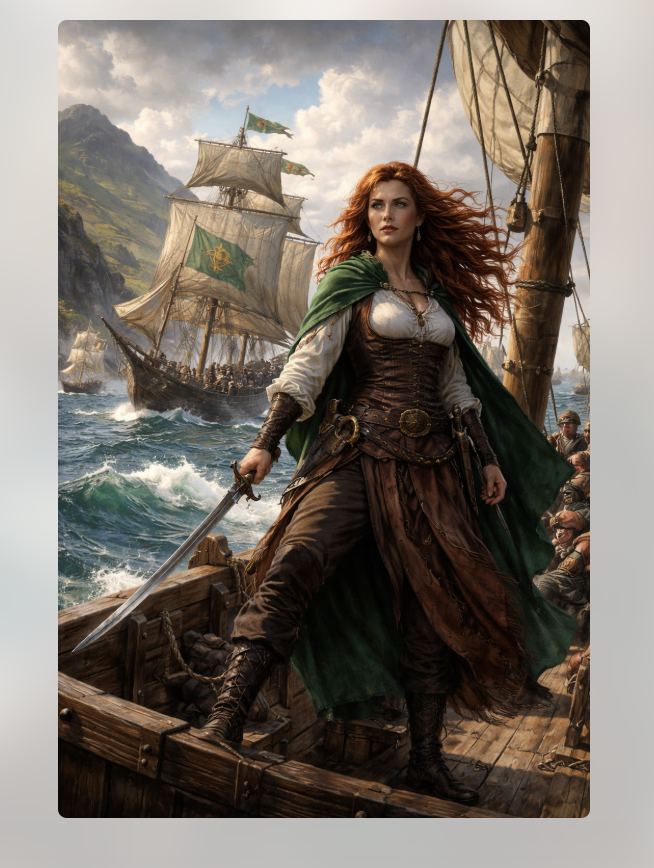
She grew up in a clan‑based society governed by a chieftain chosen from the ruling family. The Brehon Law system shaped daily life: disputes were settled through compensation, judges acted as arbiters, and enforcement came from the community. Wealth was measured largely in cattle. When Grace eventually became chieftain, she controlled extensive lands and the southern shores of Clew Bay, including the islands beyond it.
A Maritime Leader
Historian Anne Chambers, who produced a well‑researched biography of Grace, uncovered documents confirming key events in her life, including her meeting with Queen Elizabeth I. The National Maritime Museum of Ireland notes that Grace viewed Clew Bay as a gateway to distant places. She traded regularly with Spain and had a working knowledge of Spanish. She also understood English well enough to converse in it.
Her voyages took her as far as Barra in the Outer Hebrides, and she conducted cattle‑raiding expeditions along the coast. She commanded longships capable of carrying 200 men and introduced a toll for safe passage through her waters—an early form of maritime taxation.
A Changing Ireland
During Grace’s lifetime, Ireland underwent dramatic political and social upheaval. In the 1500s, English influence expanded from limited control to full conquest, transforming Ireland into an English colony. By the time of her death, the Brehon laws and Gaelic customs she was born into had largely been outlawed.
For Grace and her family, the English reconquest brought hardship and loss. Her lands fell under the authority of Sir Richard Bingham, the English governor of Connacht, who viewed her as a threat and believed she had overstepped the bounds of a woman’s role. His hostility was relentless. Her eldest son was murdered in a dispute with Bingham’s brother, Captain John Bingham. Grace herself was captured during clan conflicts, and gallows were built in anticipation of her execution. She was only released after Irish chieftains negotiated and offered hostages on her behalf
The Journey to meet the Tudor Queen
In 1593, her youngest son Tibbot was captured by Bingham, charged with treason, and imprisoned in Athlone Castle. Determined to save him, Grace undertook a dangerous voyage around the Irish coast to seek justice directly from Queen Elizabeth I.
She learned who at court could influence the queen and secured a scribe to prepare a formal petition. Despite being known in England as a rebel leader for over forty years through Richard Bingham, she was granted an audience with Elizabeth. The meeting was a success: Tibbot was freed, her stolen lands were restored, and she was permitted to continue her maritime activities. Grace lived until 1603 and remained active at sea into her later years.
Legacy
Grace was written out of historical records at the time, it could be said because Irish historians at that time portrayed Gaelic women as patriotic, Roman Catholic and charitable (stated by Anne Granger). Ireland did not have an overall leader at the time but from what we can see there were occasions that chieftains came together. Grace was fighting for her corner of Ireland and did manage to keep it during her lifetime. She was an inspiration for later women fighting for a united Ireland.
